
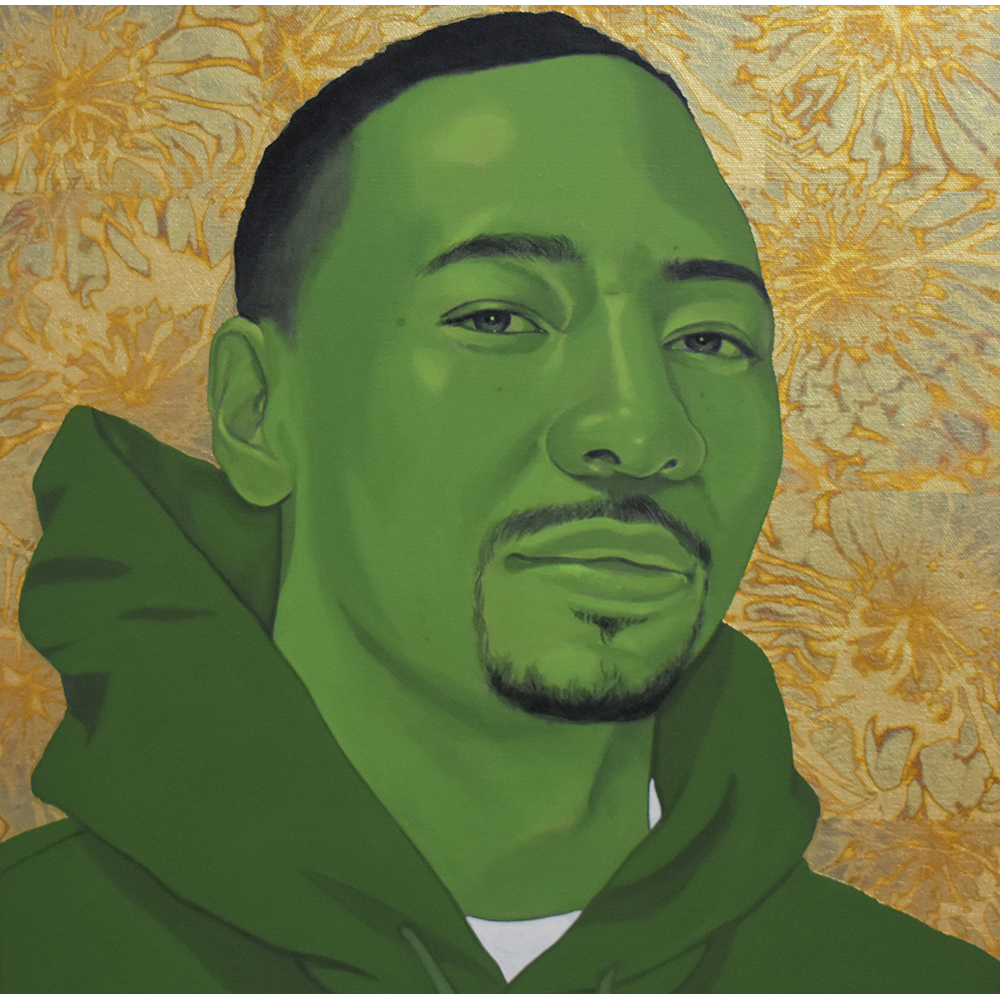
Clarence Heyward, In My Hood #28, acrylic and variegated leaf on canvas, 2023, 17 x 17″ framed
Black History Month: Stunning Artworks by Black Artists at Turner Carroll Gallery
Black History Month is an important month in the art world. It’s a time when museums, galleries, critics, and curators focus on masterful artworks by Black artists. So many Black artists and artists of the African diaspora have changed the course of art history forever, innovating new methods and techniques, reevaluating historical narratives, and bringing stunning visuals to the artworld with vastly diverse perspectives. This month, Turner Carroll Gallery is excited to bring fantastic artworks by Black artists to the spotlight. We also recognize that the skills of all artists, regardless of color, nationality, religion, or gender, is important every day of the year. 200 years from now, when future generations look at artworks in museums, they’re likely to most love the paintings that reach into their souls.
Click here to view our curated selection of works for Black History Month.
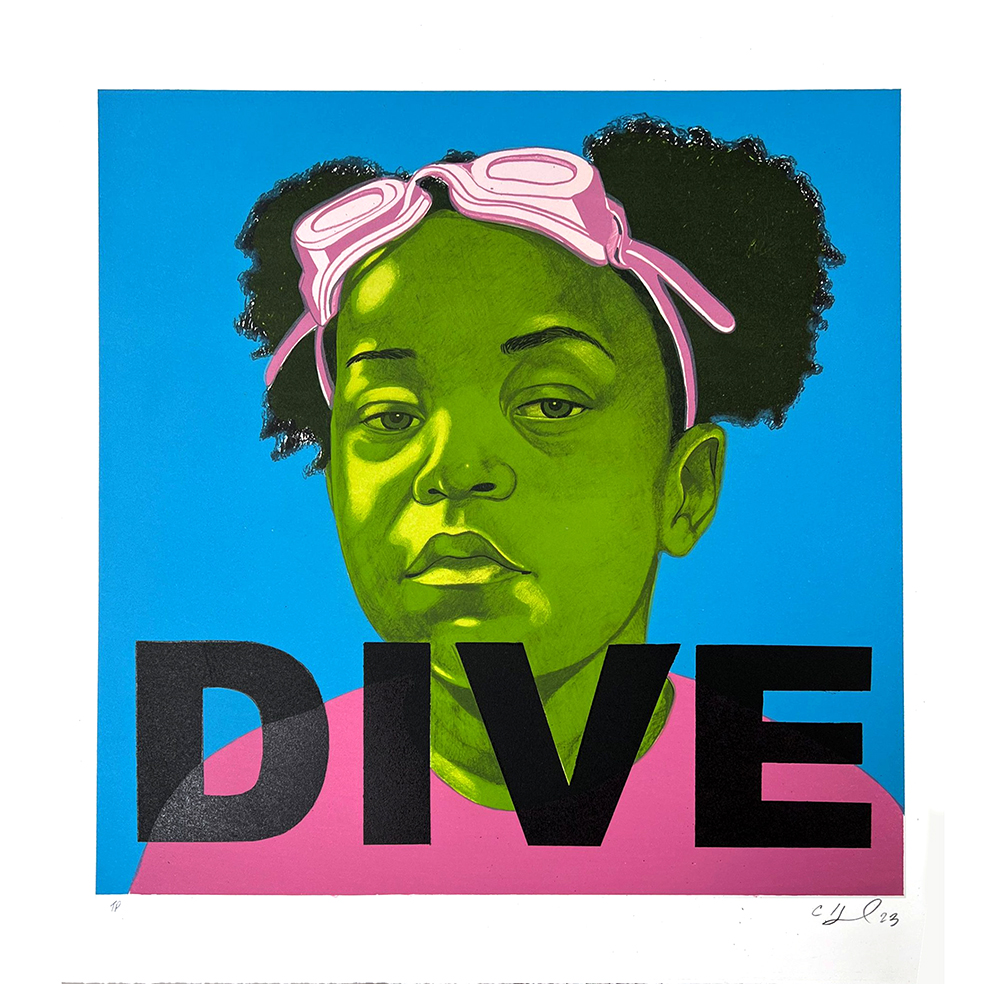
Clarence Heyward, Deep Dive, lithograph on paper, 2023, 23.5 x 23.5″ framed
Clarence Heyward, based in North Carolina, is a painter whose work addresses cultural truths and stereotypes. Heyward’s paintings and prints are deeply personal, and his subjects are often members of his family. Heyward frequently paints his subjects with chroma key green skin, using the language of green screens to bring awareness to the way we project our beliefs on the subjects. While this evokes a history of discrimination, it is also hopeful, pointing out the fact that identity is not fixed and ever-evolving. In his In My Hood series, Heyward paints accomplished Black leaders in hoodies, challenging the notion that a hood signifies danger after the shooting of Trayvon Martin. The artist asks, why are people threatened by Black men wearing something that feels comfortable? Why is their comfort threatening?
Heyward’s newest series of paintings including Deep Dive are based on the Civil Rights Swim In, a catalyst for the passing of the Civil Rights Act. In the 1964 Swim In, black and white protesters jumped into the whites-only pool at a hotel in St. Augustine, FL, after the owner poured acid in the pool to drive the mixed race public away. Heyward includes the pH scale in these paintings, alluding to the measurement of danger in society. Deep Dive is Heyward’s message to his daughter–the subject–to keep diving in even in the face of these challenges.
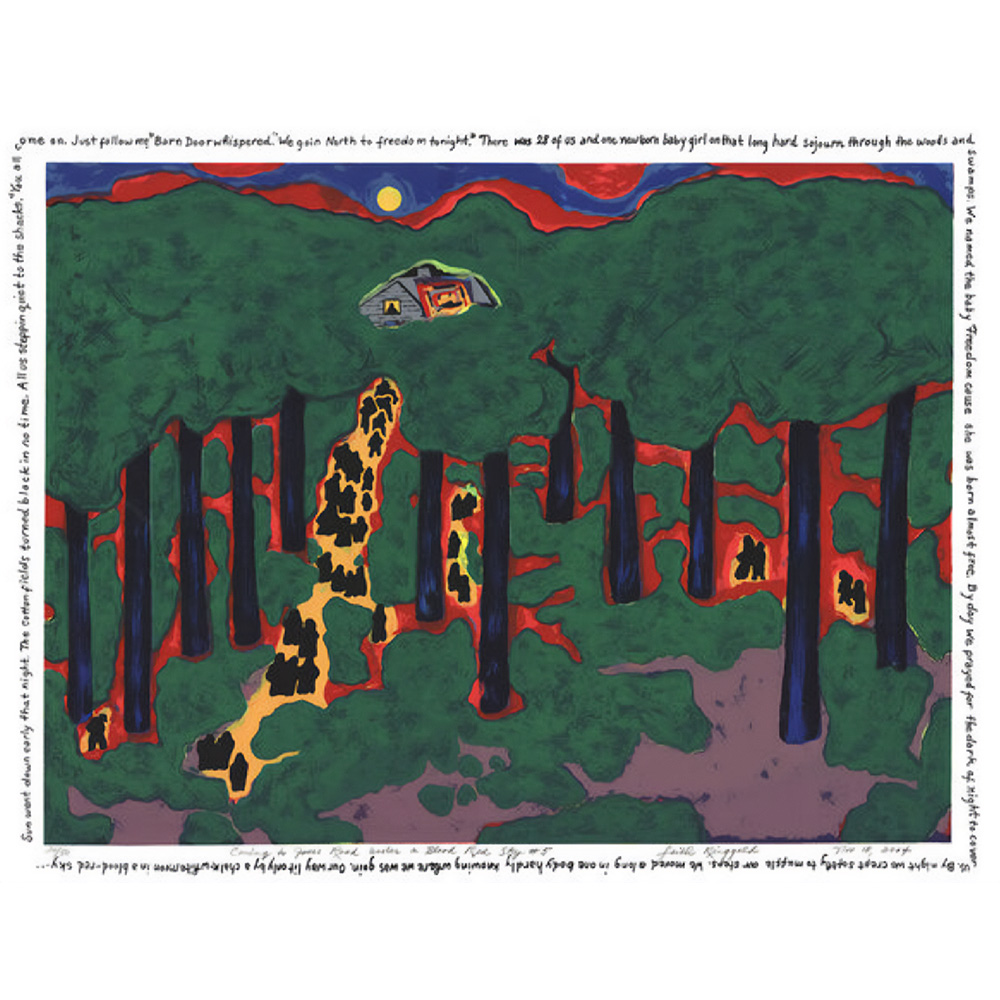
Faith Ringgold, Coming to Jones Road Under a Blood Red Sky, serigraph on paper, 2004, 35 x 45″
Faith Ringgold’s paintings and quilts are known for their powerful storytelling about the African American experience in the 19th and 20th centuries. The painted textiles unite African-American folk traditions and historically feminine domestic art forms.
This particular scene–Coming to Jones Road Under a Blood Red Sky–is from the story of two runaway slaves migrating North via the Underground Railroad. “Jones Road” leads to a small white house where they will be saved, but they are still in danger on the road. This is an allegory to Ringgold’s own experience moving from Harlem to New Jersey, where her neighbors on Jones Road viewed her presence as a threat. Ringgold’s written story wraps around the edge of the print.
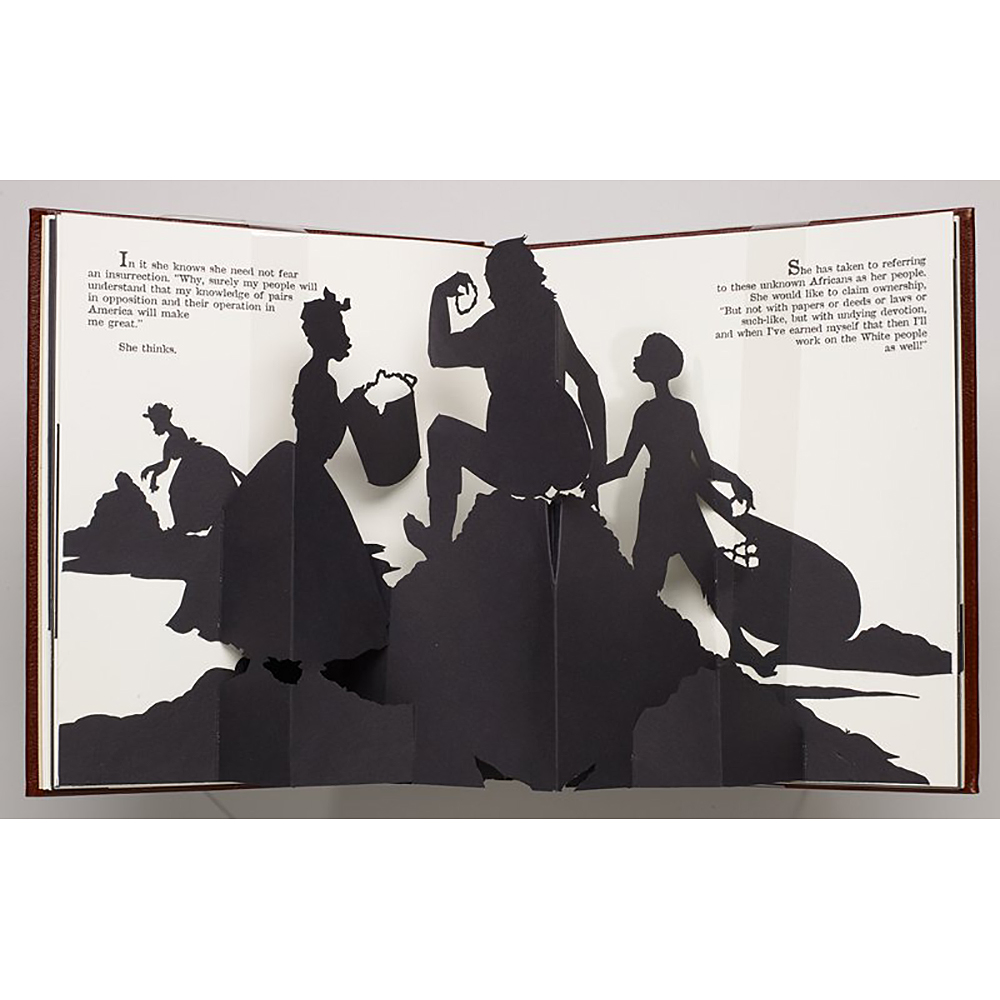
Kara Walker, Freedom: A Fable, lithograph and laser-cut silhouettes, 1997, 9 x 17″
Kara Walker is regarded as one of the most acclaimed contemporary American artists. Walker is a contemporary painter, silhouettist, print-maker, installation artist, filmmaker, and professor who explores race, gender, sexuality, violence, and identity in her work. Her cut-paper silhouette images, a technique popular in 19th century narrative illustrations, are bridges between the slavery folklore of the South and the identity and gender issues that concern modern African American women.
In Freedom, A Fable, Walker uses the creative medium of a pop up book, a medium familiar and easy to digest for the American public which is often used for children’s books. In it, as the Princeton Museum of Art describes, “she tells the story of an enslaved woman who is emancipated but still experiences oppression, discovering that freedom is indeed a fable. Walker’s tale addresses the persistence of negative stereotypes that emerged in the minstrel shows, novels, and artworks of the eighteenth and nineteenth centuries.”
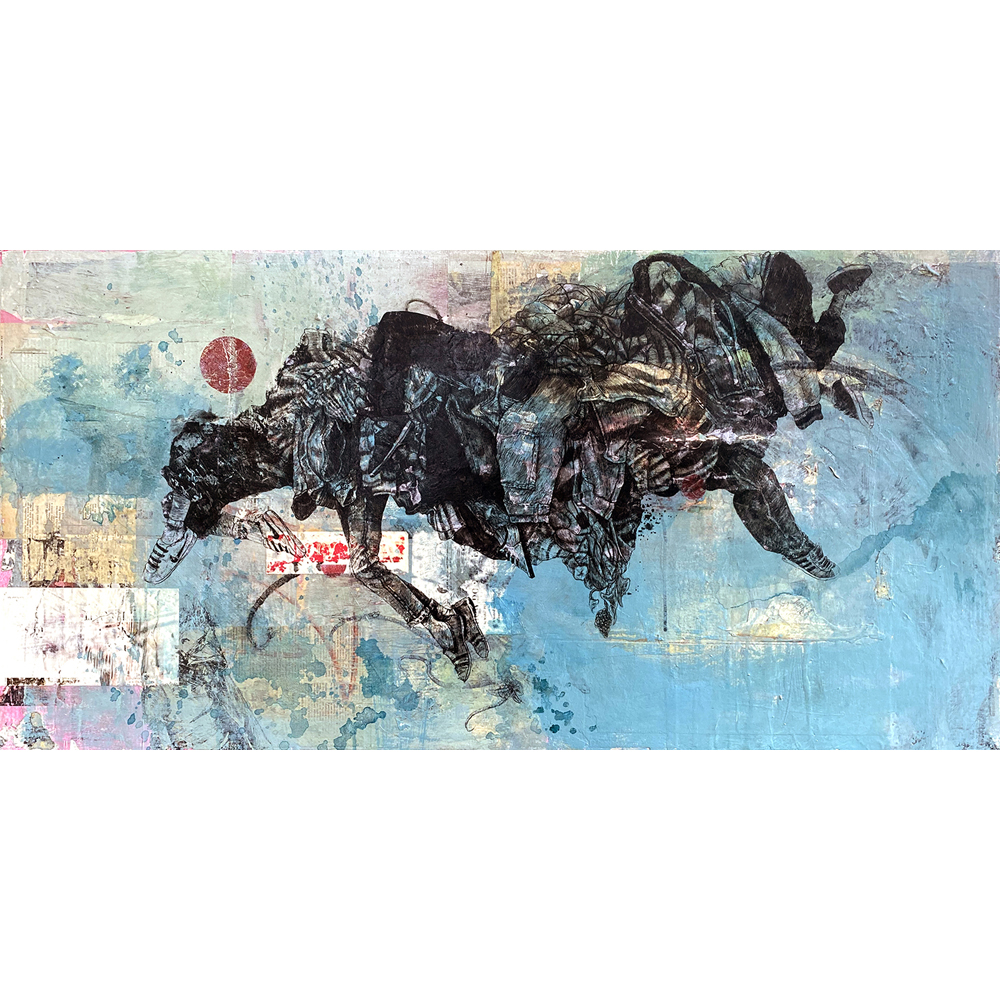
Antoine Williams, Othered Suns Series (Painting #2), mixed media, 2022, 24 x 48″
Antoine Williams’ mixed-media work investigates his cultural identity by exploring power, fear and the perception of signs within society. Heavily influenced by science fiction, and his rural upbringing in Red Springs, North Carolina, Williams created his own mythology about the complexities of contemporary Black life. He received his BFA from the University of North Carolina, Charlotte, and his MFA from UNC Chapel Hill. WIlliams is the recipient of the prestigious Joan Mitchell Award, and his work has been shown in major museum exhibitions.
Williams’ Othered Suns painting, as Duke Arts writes, “deals with the themes of migration and the body. Historian Robin D. G. Kelley writes in his book Freedom Dreams: The Black Radical Imagination that “the history of Black people has been the history of movement—real and imagined.” This piece explores the physical, emotional, psychological, and temporal landscapes Black bodies have had to continuously traverse in order to find spaces of freedom. Pulling from the ideas of afropessimism and monster theory, Black bodies find themselves in a perpetual migration in Othered Suns. The wheat paste installation consist of legs jutting out from an entanglement of clothing and fabric. Clothing references the ubiquity of white supremacy. The massive entanglement of fabric has become a major impediment to movement and access—rendering this act of migration in a form of stasis.”

Stephen Hayes, Cash Crop, 15 lifesized mixed media figures, with concrete, woodblock, and iron, 2010
Stepehen Hayes is a multimedia artist who uses woodcuts, sculptures, and installations small and large using largely found materials. He draws on social and economic themes ingrained in the history of America and African-Americans. His approach is simple: “If I can’t find it, I’ll make it. If I can’t make it, I’ll find it.”
Stephen Hayes’ Cash Crop references Black bodies as a crop, or traded commodity for cash. He was inspired to create these sculptural figures after reading the plans for the Brooks slave ship. Each body is attached to its own version of the Brooks ship, with 15 bodies in the original installation, each chained and bound. Turner Carroll Gallery offers individual sculptures for sale as part of this series.

Emmie Nume, Life in a Day, mixed media on canvas, 2022, 50 x 60″
Emmie Nume is a young Ugandan artist and rising star. His approach to painting is deeply intuitive and his figures emerge from his brush with no sketches or reference images; their expressionist and freely original forms are intimate, emotional, and dynamic. Nume’s work has already been exhibited in prestigious international venues such as Art Basel Miami, and he was awarded a Tracy Emin residency in London for 2023 despite still being in his 20s.
Life in a Day depicts Emmie in his studio in Uganda. Surrounded by the artifacts of everyday life and his varied mundane and artistic tools, Numie challenges us with this intimate view of his personal space. Whitehot magazine featured this painting as one of the gems of Art Basel Miami in 2022.
Author: Sophie Carroll