
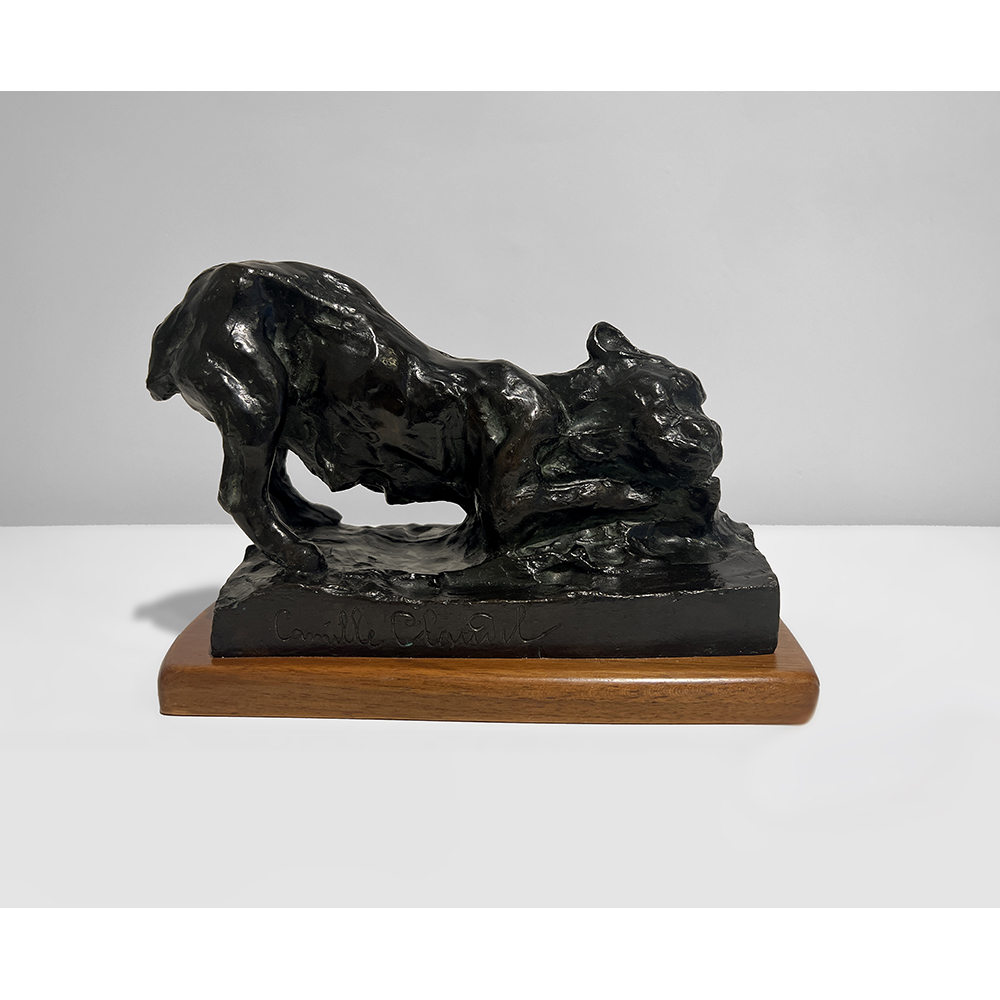
Blasfemme, a Turner Carroll exhibition shown in March 2024, is a testament to the enduring impact of women artists who challenged conventions throughout the 20th and 21st centuries. The exhibition honors those who dared to be “blasphemous,” and features pioneers like Camille Claudel, Judy Chicago, Louise Bourgeois, Kiki Smith, Nadya Tolokonnikova, Faith Ringgold, Leonora Carrington, Kara Walker, Angela Ellsworth, Meridel Rubenstein, Swoon, Monica Lundy, Harmony Hammond, Hung Liu, and Alice Neel.
Camille Claudel (1864-1943) was born in France, and is the eldest of this formidable, international group of women. She defied her mother’s wishes that she not pursue such an “unladylike” vocation as sculpting, and nonetheless went on to become one of the most acclaimed sculptors France ever produced. Claudel was Auguste Rodin’s assistant, muse, well-known lover, and the subject of multiple films, books, plays, and even an opera.

Claudel was fiercely independent and self-assured. She made Rodin sign a contract stating that in return for her continued assistance in his studio, he must promise to take no more female assistants, take Claudel to Italy for a year, and then marry her upon their return. When Claudel became pregnant with Rodin’s child he broke the contract. Claudel exercised her own agency by having an abortion, and then proceeded to devote herself entirely to her work. Not long after, her family had her involuntarily locked away in two asylums for the final thirty years of her life, thereby denying the world additional works by an artistic genius far ahead of her time. Even with only 90 extant works, Claudel now has a museum devoted to her work in France, and 10 of her exceedingly rare works reside in U.S. museums. Claudel’s 2024 career survey by the Art Institute of Chicago and the J. Paul Getty Museum is the first major American survey exhibition.
Louise Bourgeois (1911-2010) was a matriarch in her own right, and explored the intricacies of the human psyche through deliberately provocative imagery. Bourgeois often combined female nude body parts and architectural elements relating to a home or cell to suggest the entrapment of women via societal norms of housewifery. Leonora Carrington (1917-2011), like Camille Claudel, was rebellious and was institutionalized at two different points in her life. Carrington escaped to Mexico, and later founded the Mexican women’s movement in the 1970s. Her artistic endeavors were imbued with a sense of the mystical and the surreal, and reflected her deep connection to the realms of magic and the subconscious. Her writings inspired the theme of the 2022 Venice Biennale, The Milk of Dreams.

Left: Alice Neel, Victoria and the Cat, 1981, lithograph and screenprint, 46 × 31″, ed 79/100
Right: Angela Ellsworth, In Memory of Our Sister (Jane), 2023, 12,253 black dress pins / boutonnière pins, wood, fabric, steel, 23 x 13 x 12″
Alice Neel (1900-1984) gave a new voice to women through her portraits by presenting their multifaceted needs and desires. Neel often depicted women nude or in poses considered at the time to be overtly provocative.
Faith Ringgold (b. 1930) grew up without knowledge of Black role models in the visual arts. She has devoted her creative life to describing herself as a Black artist, and creating imagery based on her specifically Black lived experience. Often the experiences she depicts are uncomfortable and harrowing, and deal with slavery, discrimination, and other injustices inflicted upon Black people.

Judy Chicago (b. 1939), who has long lived in New Mexico, is currently enjoying a career retrospective occupying the entirety of the New Museum in New York. Her work will be featured in exhibitions across Europe this year, as well. Her iconic work, The Dinner Party, is permanently featured in its own gallery in the Brooklyn Museum. The Brooklyn Museum also features major works by Harmony Hammond, another important New Mexico woman artist.
Judy Chicago’s impact reverberates not only through her own artistic creations, but also through her encouragement of two outstanding younger women artists: Caledonia Curry, (a.k.a. Swoon), and Nadya Tolokonnikova who is the founder of Pussy Riot. Often hailed as the Godmother of Feminist Art, Chicago never had biological children of her own, but her two “adopted art daughters” share her drive to make the world a more equitable place for all living beings. It was Chicago, who introduced both of these revolutionary artists to Turner Carroll.

Caledonia Curry (b. 1977) has train-hopped, crowd surfed, and wheat pasted her name into art history as the first female street artist to shatter the glass ceiling of museum collections. Her practice, marked by its social commentary and ephemeral beauty, expands the traditional boundaries of an art space by using the city itself as a gallery. Swoon has been featured in the biographical film Fearless, as well as in the films Street Heroines and Banksy’s famous Exit Through the Gift Shop. When MoMA took notice and asked Swoon to bring her works to the museum for consideration, she loaded up her bicycle with rolled artworks, rode over, and the museum promptly collected them. Now, her work is found around the world, from Hong Kong to her current retrospective exhibition at the Taubman Museum in Virginia. In autumn 2024 she will have her premier exhibition in Bangkok.
Meridel Rubenstein (b. 1948) and Kiki Smith (b. 1954) present the aging body as magical and beautiful, and exposing its natural fallibilities. Rubenstein’s interdisciplinary approach blends art and ecology, and asks us to reconsider our relationship with the natural world. Rubenstein is currently recreating the original Garden of Eden in Iraq.
Hung Liu (1948-2021) and her most prized student Monica Lundy (b. 1974) both defy controlled narratives. Liu left Maoist China to obtain American citizenship and paint defiant portraits of the hardships of life in China. Lundy uses outcast materials such as burned paper, coffee, and coal, to create gorgeous portraits of women who were locked up in prisons, homes, or asylums for nothing more than disobeying their husbands, or being “too loud.”å

Angela Ellsworth (b. 1964), a New Mexico artist, is the descendant of Mormon polygamist apostle and past president of the Mormon Church, Lorenzo Snow. Her great-great-grandfather Snow was ultimately imprisoned for cohabitating with nine wives. Ellsworth, a queer woman, rejected her Mormon upbringing, and devotes herself to creating artworks exploring the pain of past wives’ bodies. Her Seer Bonnets, with corsage pins facing inward toward the scalp of the would-be wearer, are far too painful to be worn. Instead, they reference the sewing and domestic skills practiced by the polygamist wives. In the last year, Ellsworth’s works have been featured in the Smithsonian American Art Museum, Museum of Contemporary Art in Denver, and are currently up at the Vladem Museum of Contemporary Art.
Nadya Tolokonnikova (b. 1989) was born in Siberia in a politically pivotal year. Her journey is a testament to the power of activism and resilience. Nadya put her own well-being at risk by challenging oppressive systems in Russia, and ended up imprisoned by the Putin regime for two years in a Siberian gulag. Nadya persevered even though she was forced to sew Russian police and military uniforms on broken sewing machines for 16 hours per day, and continues to be a thorn in the side of authoritarianism in her new life in exile. Tolokonnikova’s recent Putin’s Ashes project shown at [CONTAINER] in 2024 resulted in Putin placing her on Russia’s most wanted list, and ultimately trying and convicting her in absentia. Numerous museums throughout the U.S. and in Europe are actively collecting Tolokonnikova’s work. Her first U.S. museum exhibition was at Dallas Contemporary two months ago, and her first European solo museum exhibition opens at OK Linz Museum in Austria in June.
The legacy of these influential female artists is not confined to the walls of galleries but reverberates through time, inspiring the next generation of creatives to embark on their own journeys of artistic rebellion. Blasfemme is a call to action, imploring women to stand up for themselves, each other, and their right to bodily and intellectual autonomy.