

Jeanette Pasin Sloan’s six decade career as an accomplished woman artist is awe-inspiring. We invite you to see more deeply into this remarkable artist’s practice through the lens of art as a spiritual experience, and to see Sloan’s masterful works in person at Turner Carroll Gallery during the last days of her exhibition.
Since she was a young child, Sloan was devoted to studying the paintings of European master artists like Vermeer, Leonardo Da Vinci, and Titian. She knew that if she wanted to one day reach their level of genius, she needed to match the artistry of the most technically excellent painters in history.
After spending her youth visiting museums and churches to see European paintings, she wanted to learn even more. Sloan then earned her master’s degree in Art History from the University of Chicago. She refined her knowledge of subject matter, compositional elements, and techniques of painting and printmaking used to create great works of art, applying them to her own work.

As her life progressed and Sloan became a young mother, she turned her attention to her inner world, making time each day to practice painting. Sloan put her children to bed early each night so she could go to her sanctuary–her kitchen table–and paint. She employed her vast knowledge of historic painting vocabulary, color and compositional techniques to create her own island of peace and meditation in the form of her paintings.
Color and repetition are two integral elements of formal painting that Sloan explores in her paintings and prints. Repetition provides structure and unifies a composition. Sloan’s repeating black and white patterns, reflected in the curved surfaces of the metal cups she paints, are in art historical conversation with master artist Vermeer’s repeating black and white floor tiles and curved reflections from mirrors and glass surfaces. Sloan’s reverence for complex compositions, brilliant color, and reflective objects unites her mastery of classical techniques and her personal, contemporary style.
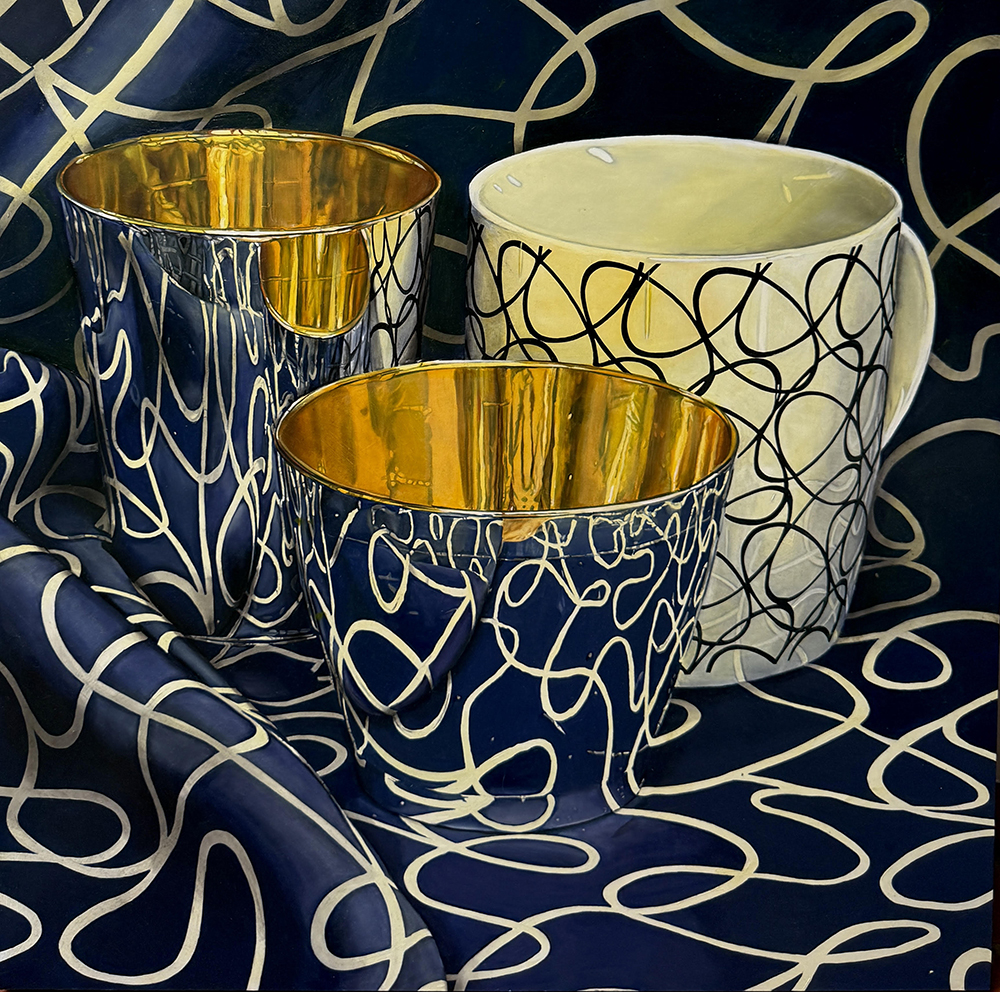
The choice of reflective objects invokes another layer of meaning: our human ability to reflect upon our own relationships with other living beings different from ourselves. In our personal relationships with others and with the planet, do we bend reality to fit our own perspectives, as is the case with the cup? Or do we transform ourselves, like the striped and dotted fabric, to fit the reality of the shapes that reflect us? Perhaps this contrast helps us see that harmony exists in the blending of two different realities; when both contrasting elements transform themselves seamlessly into one shared experience.
This type of vision-building within ourselves is the part of the spiritual “practice” of art that is required by the viewer. An artist’s completed painting is only one half of the art experience. Again referencing Sloan’s compositions, imagine if she had painted only the cloth without the cup, or vice versa? It is the viewer absorbing painting into their own psyche, adding their half of the story, that completes its meaning.
Author: Sophie Carroll