
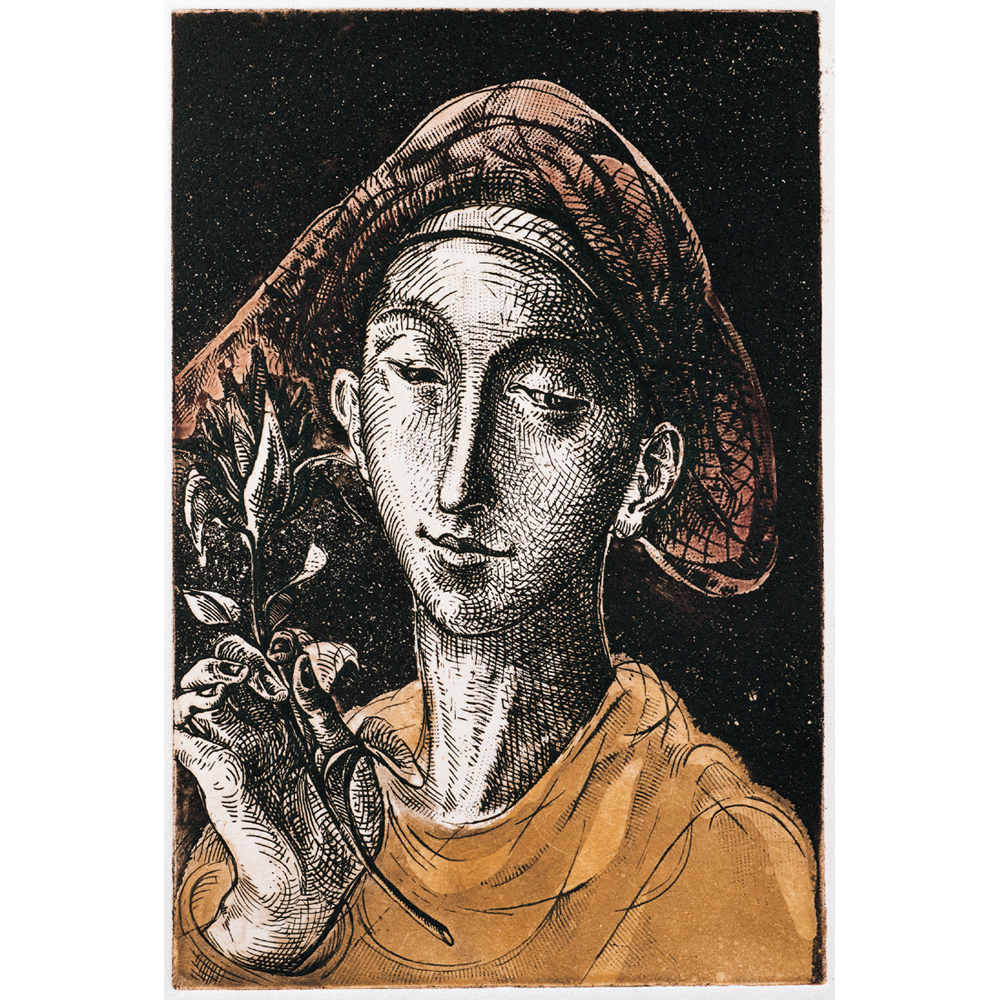
Traian Alexandru Filip was a Romanian artist who worked in the state engraving studios under dictator Nicolae Ceausescu in the latter half of the 20th century, who later escaped to New Hope, Pennsylvania. His intaglio engravings found international acclaim and boldly criticized the Romanian authoritarian government, and Traian was one of the first artists–and kindred spirits–that Tonya and Michael discovered shortly after founding Turner Carroll Gallery in 1991.
Tonya and Michael discovered Traian at the Chicago Art Fair in 1991 at a booth of Romanian artists including the acclaimed gallerist Mihai Nicodim. The minute the partners saw Traian’s work, they knew it was incredible. They were unsure if an American audience would collect the haunting Eastern European imagery, but Tonya and Michael felt deeply compelled to collect and show it.

Tonya and Traian instantly connected at the fair and bonded over their shared inspiration in William Blake. Tonya wrote her university thesis on William Blake’s religious illustrations, and Traian was inspired by Blake’s view of the etching process as a religious and spiritual experience, as well as Blake’s emphasis and the duality of goodness. Both were fascinated by the spiritual symbolism from Christian, Tarot, pagan, and alchemical traditions that Traian incorporated in his work. Michael had become fascinated with Soviet propaganda after studying in Moscow, which became a major part of Traian’s subversive art against the Romanian Soviet-satellite state–he used historical symbols that intellectuals and artists would understand, but not the Soviet officials controlling Romania.
Oltre il Muro delle Parole (above) is an example of one of Traian’s most symbolically dense etchings. The title is a line from Italian poet Teresa Maria Moroglioni Dragan, who he collaborated with on an exhibition in Turin to have the opportunity to advocate for the Romanian people against their oppressive government abroad where criticism was safer. Traian represents himself in the armored man, citing the sword as the artist fighting for his freedom. Ceasescu’s faced is on the starved dog in the lower left, which has a birdcage on its head to signify that his thoughts were owned by the Soviet Union, and a scepter pointing downward to signify foolishness. The ship in the upper right signifies Traian’s hope of escape, while the playing cards in the lower left signify chance and the randomness of fate.
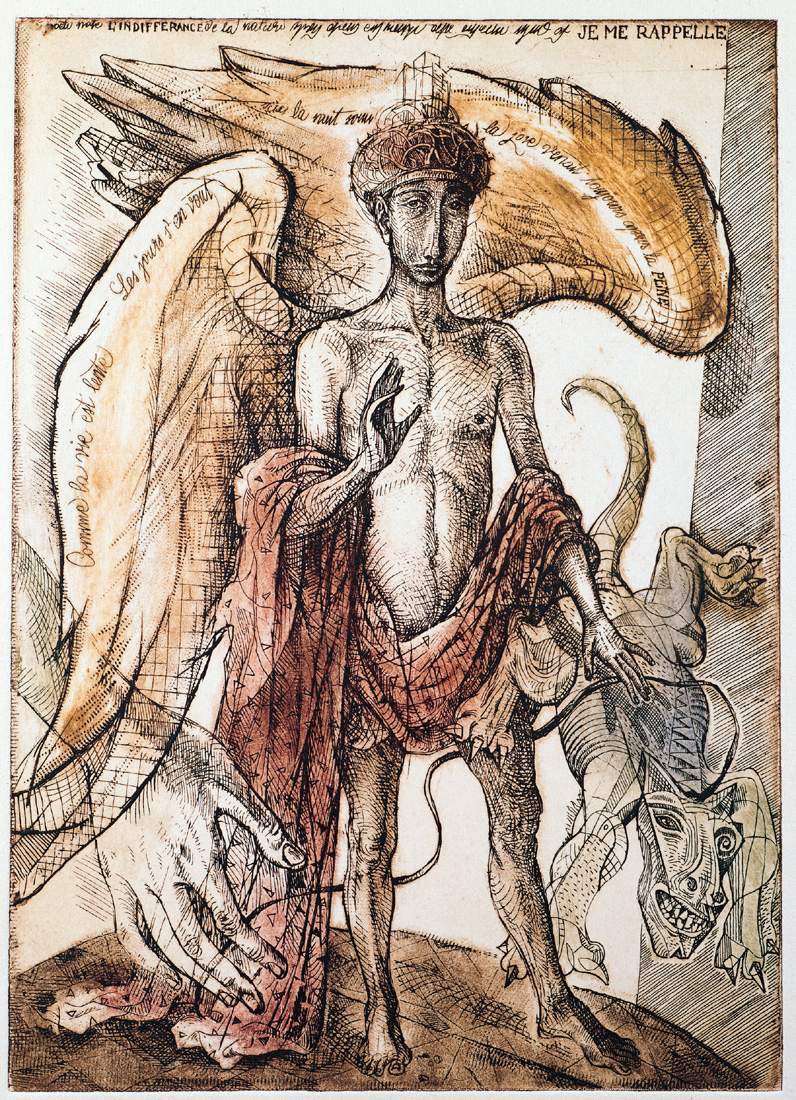
Traian Alexandru Filip was born in 1955, in Bucharest, Romania. Growing up under the regime of Romanian dictator Nicolae Ceausescu, Traian started drawing as a young child, and decided to pursue an artistic career despite the persecution artists and intellectuals faced under Ceausescu. Traian’s parents were both writers, and his mother Oltea raised Traian in a home open to artists of all types, the family hosting secret discussion circles for artists deemed illegitimate and who used anti-communist symbols.
In his early teens, Traian Alexandru Filip became a child artistic prodigy in Romania. He won the UNICEF award for graphic arts at 14 years old, and became an in-demand illustrator for Romanian periodicals. Filip was particularly inspired by William Blake and Dante Alighieri, his drawing inspired by Dante’s Inferno winning the UNICEF award.
Traian’s father Filip moved to Italy in 1972, which meant that Traian himself could not leave Romania to pursue his artistic career–Ceausescu mandated that only one family member at a time could leave Romania to avoid defection. Although Traian was accepted to L’Ecole des Beaux Arts in Paris, he could not attend the international school, and instead enrolled in the Nicolae Grigorescu Institute of Fine Art in Bucharest.

Traian specialized in intaglio etchings at the Grigorescu institute. Inspired by the religious experience and method-based art of William Blake, the method of scratching images from the intaglio plate was of utmost importance to the artist. To make an intaglio, artists create an image with a needle-like tool through a piece of wax paper on top of a metal plate and use acid to deepen the lines, which are then inked and printed on paper.
Traian joined the Romanian Union of Artists in the 1980s, which secured him access to a printing press at all times, but refused to join the Romanian Communist Party. In 1985, he collaborated on an exhibition with the famous Italian poet Teresa Maria Moroglioni Dragan, and displayed a group of etchings in Turin to enormous acclaim–the Vatican Museum bought two, and Traian was finally reaching international acclaim. This group of etchings were distinctly political however, depicting Ceausescu in various undermining positions like with a birdcage in place of his head or with the fool’s cap Tarot symbol. When the Romanian government discovered these images, they placed him on Romania’s blacklist and threatened him with imprisonment while also prohibiting him from holding employment.
The artist attempted to escape to Germany in 1988, but was intercepted by Soviet officials and brought back to Romania. Traian finally succeeded in escaping in 1989 to Sweden and then France, eventually securing an Exceptional Artist visa in the United States at the end of the year. He settled in New Hope, Pennsylvania, and focused on painting and illustration jobs, as well as finally being able to attend his international exhibitions. His work heavily features angels in this period, inspired by Blake’s use of angels to depict the duality of human nature–purity and chaos. His wife and children joined him in New Hope in 1993, the same year this incredible artist’s life came to an untimely end.

Tonya Turner Carroll and Dan Grigorescu, Traian’s friend, in Romania in 1992
Traian connected Tonya and Michael with other Romanian and Eastern European artists over the course of their friendship, and inspired them to visit Romania in 1992. The Turner Carrolls met with Traian’s mother in law and former assistant, and they explored the Grigorescu institute where Traian studied engraving in the 70s. This visit launched a lifelong passion for Eastern European art, and after Traian’s death, his wife asked Michael and Tonya to handle and archive his estate. As part of this work and after connecting with him in Romania, the couple brought Matei Sandu, Traian’s apprentice, to Santa Fe to print the rest of Traian’s plates and cancel them.
Tonya and Michael’s incredible connection with Traian, respect for his work, and connections with people close to him led the Turner Carrolls to write a book about the artist, published in 1997. This research publication was printed in Verona, where Michael and Tonya traveled to oversee every detail of the printing process, even bringing Traian’s original prints to color-match against the printer’s proofs.

Since the Turner Carrolls first connected with Traian, the artist’s work has joined the Tony Podesta Collection, Wesleyan University Art Museum, Vatican Museum, and international private collections including the US, Mexico, Egypt, France, India, and beyond. Turner Carroll Gallery is proud to have this incredible artist as one of our very first roots in the international art world, and our passion for artists with incredible stories is and will continue be the guiding philosophy of our gallery–now in its 35th wonderful year!
Author: Sophie Carroll