

Today’s featured artist is William T. Wiley, a California “Funk Movement” artist rooted in the Bay Area. Wiley was born in 1937 in Indiana, moving to San Francisco in the 1960s for art school and establishing a deep artistic community in the area. Wiley eventually joined UC Davis’s art faculty, and became a beloved teacher to prominent students such as Bruce Nauman, Deborah Butterfield, Richard Shaw, and Stephen Laub, while teaching alongside other well-known faculty including Robert Arneson and Roy DeForest. Wiley’s work was featured in major international exhibitions including the Venice Biennale, Whitney Biennial, De Young Museum, Smithsonian, and SF MoMA.

In the 1960s and 70s, Wiley was an integral part of the Bay Area Funk movement, a movement reacting against dominant East Coast minimalism and abstraction, favoring figurative subject matter, humor, wordplay, satire, found objects, quirky imagery. It was during this beginning phase of Wiley’s life that he achieved a career landmark: a solo show at the San Francisco Museum of Modern Art.
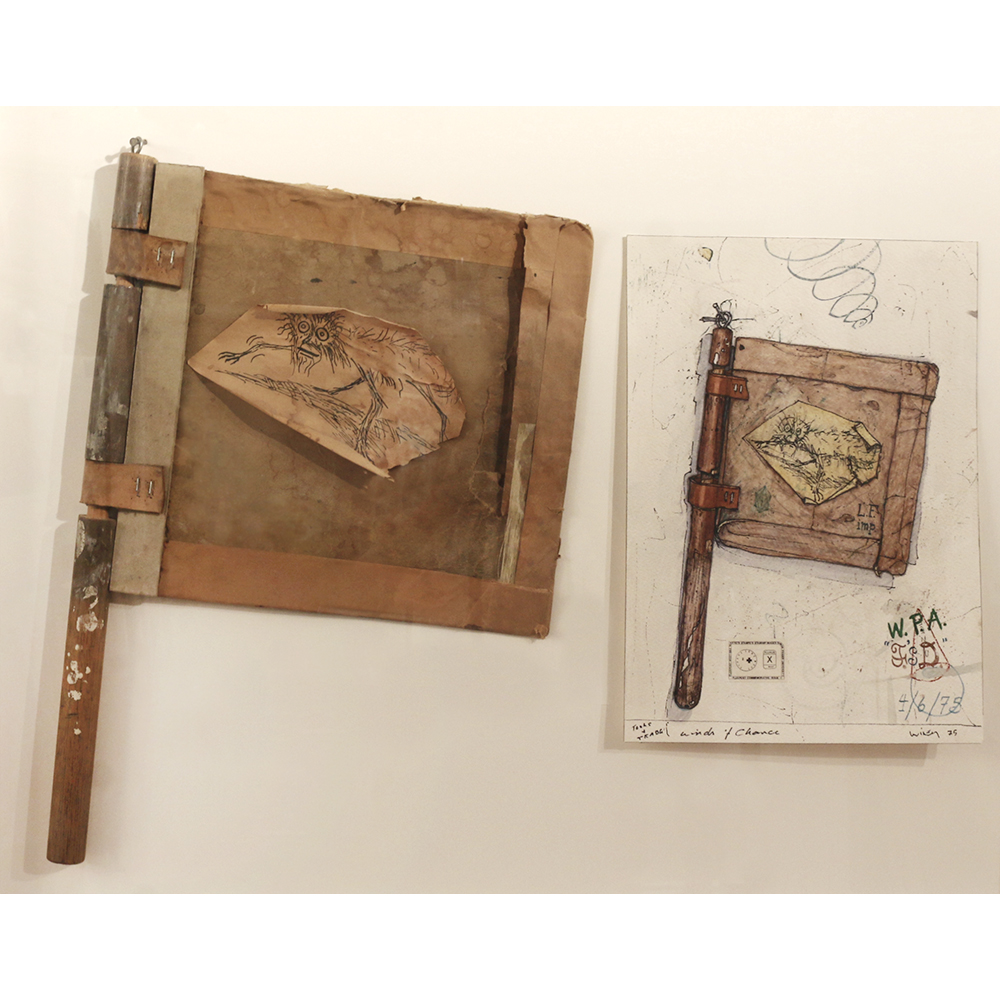
Wiley’s art was extremely versatile: he worked in painting, drawing, collage, sculpture, assemblage/found objects, printmaking, film, performance art, theater, and more. He continuously mixed languages, symbols, text, puns, absurdity, philosophical and political commentary. Wiley used repeated symbols throughout his works including a character named Mr. Unnatural, masks, skulls, and family portraits.

Drawings for Landfall Press by William Wiley
Wiley worked closely with Landfall Press and master printer Jack Lemon throughout his career–although Wiley was elusive in the wider art world, rebelling against the public personas of many East Coast artists, the two were close friends and Wiley would frequently experiment with new projects at Landfall.

Author: Sophie Carroll