

Nadya Tolokonnikova, WITCH triptych, engraved birch plywood, 48 x 108″, 2024
“[There is] a shift of attention in contemporary art: magic, mysticism and spirituality, animism, the figure of the witch, the medium and the shaman…figuring in academic revisions and rediscoveries.”
-J.J. Charlesworth, Art Review, The Return of Magic in Art
Nadya Tolokonnikova utilizes every artistic tool available to her to affect positive social change. She harnesses the power of art as a form of magic, using ritualistic performances and their resulting relics, to articulate intentions, raise energy, manifest desires, and to undergo transformation and catharsis.
With exacting focus and intention, Tolokonnikova employs colors, shapes, and materials chosen specifically to raise energy for her desired outcome.
Tolokonnikova refers to works shown here, as her Dark Matter series. She premiered Dark Matter at the OK Linz Museum in Austria in 2024, as “amulets of hope” for a brighter future. In these works, Tolokonnikova combines the color black, sacred birch wood, images of her own body, as well as symbols and calligraphy she adapts from Slavic religious texts to conjure a brighter future.

In 2011, Tolokonnikova and her feminist activist collective Pussy Riot, staged a ritualistic protest known worldwide as Punk Prayer, inside Moscow’s Christ the Saviour Cathedral. They chanted “Virgin Mary, Mother of God, become a feminist. Join our protest, Holy Virgin. Virgin Mary, Mother of God, banish Putin.”
Tolokonnikova writes that “during the Pussy Riot trial of 2012, calls were made to burn Pussy Riot at the stake for heresy and witchcraft.”

Tolokonnikova’s choice to call upon the sacred religious figure of Virgin Mary in Moscow’s revered cathedral was purposeful. She hoped to invoke the powerful goddess to use her mystical powers to drive away the authoritarian dictator.
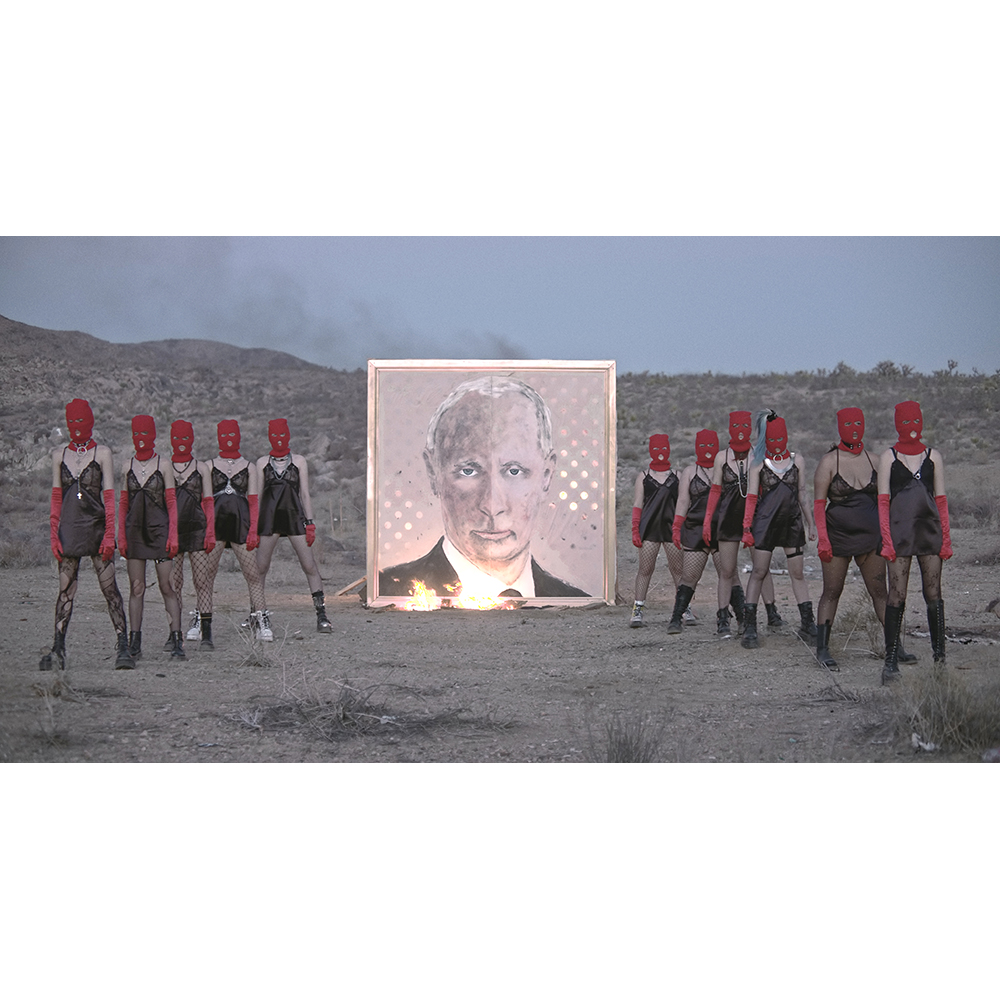
Nadya Tolokonnikova, Putin’s Ashes III, photographic print on aluminum from original video,
In 2022, Tolokonnikova staged a ritual in which she burned a large portrait of Vladimir Putin. She invited only Russian and Ukrainian women who professed profound hatred of Putin to participate to enforce the ritual’s power. Tolokonnikova and the participating women burned the physical image of the dictator and transformed him into ashes, which Tolokonnikova and the other participants scooped up into vials. The ashes, representing the destruction of the authoritarian ruler, were presented as artwork relics of the ritual. This enabled the ritual to expand its audience, as Putin’s Ashes artworks were added to permanent collections of museums including The Brooklyn Museum, The Ackland Museum of Art, and the Los Angeles Museum of Contemporary Art. Tolokonnikova’s Putin’s Ashes film was exhibited at Dallas Contemporary, OK Linz Museum in Austria, Indiana State University Museum of Art, Deitch Projects, and [CONTAINER] Santa Fe. Tolokonnikova’s ritual thus incorporated participants across the globe.
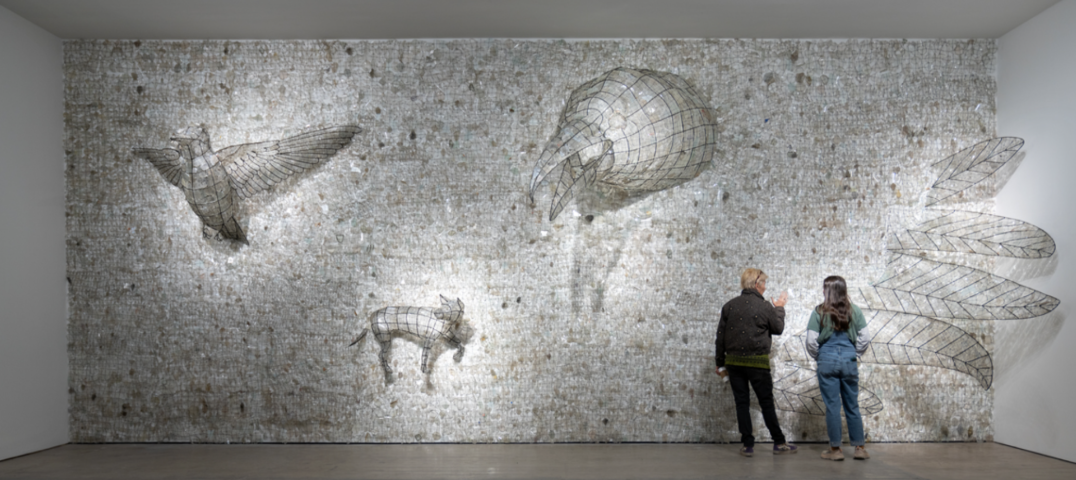
Erika Wanenmacher’s glass installation at SITE Santa Fe in 2025
Women artists have led the quasi-alchemical practice of transforming ritual into artistic relics. Hilma af Klint’s mystical abstractions influenced by her communications with the spirit world broke all past attendance records at the Guggenheim. Occult imagery by artists such as Leonora Carrington and Remedios Varo has been “rediscovered,” as evidenced in Cecilia Alemani’s 2023 Venice Biennale The Milk of Dreams and The Peggy Guggenheim Museum’s Surrealism and Magic. Erika Wanenmacher’s very recent Site Santa Fe exhibition This is What Time Travel Feels Like, Sometimes, focused Wanenmacher’s practice of intentional materiality and casting spells as her art form. As The Lannan Foundation writes about Wannenmacher, “she channels her own beliefs about the spirit world, goddesses, magic, and spells into maverick, multimedia art pieces.
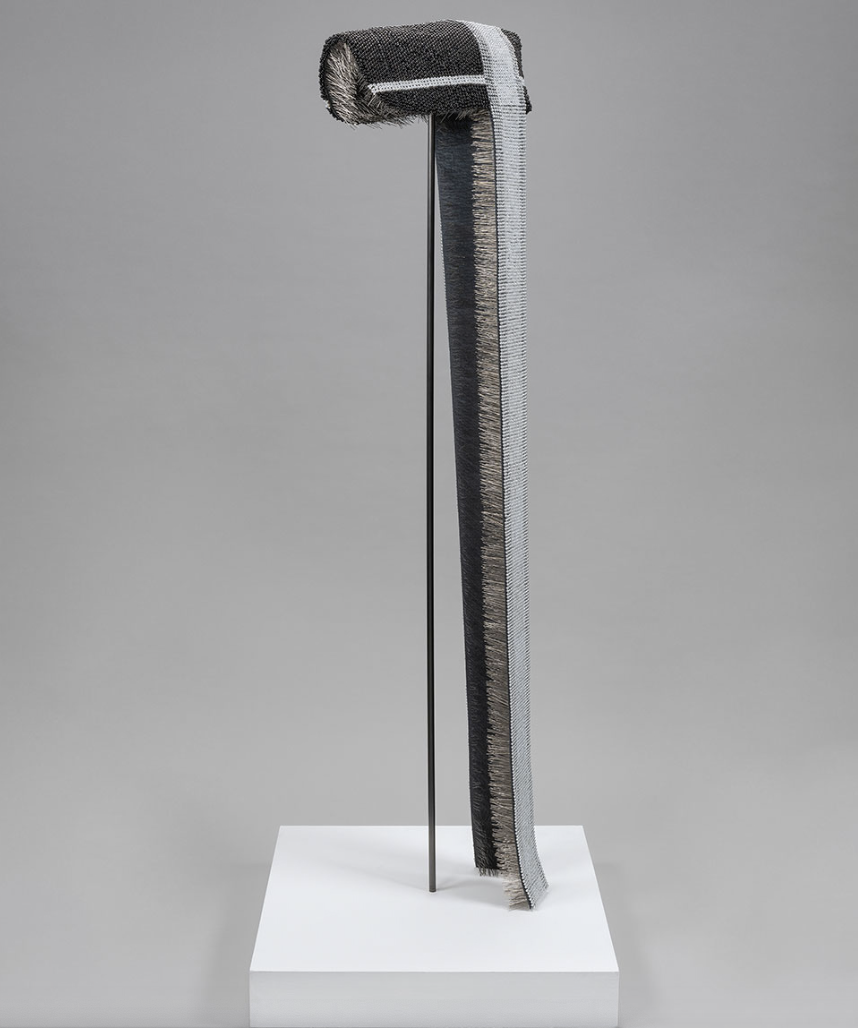
Turner Carroll is, itself, a place where ritual and magic constitute our curatorial practice. We harness the energy and memory of countless generations who made our beloved Canyon Road the remarkably unique place it is today. From a family residence built in 1863 made of mud bricks and wooden floors, Turner Carroll Gallery has built international art history from our location on Canyon Road. We’ve continued the Canyon Road tradition of foregrounding strong women artists, bringing boundary-pushing, international conceptual artists like Nadya Tolokonnikova, whose show opened June 28 at Turner Carroll, social practice artist Swoon, Chinese artist Hung Liu, and Japanese artists Eri Imamura and Etsuko Ichikawa. These new powerhouses show alongside New Mexico luminaries like Angela Ellsworth, Judy Chicago, Raphaelle Goethals, Mokha Laget, Rosemary Meza DesPlas, Marietta Patricia Lies, Florence Pierce, Agnes Martin, Jeanette Pasin Sloan, Jamie Brunson, Karen Yank, and Sharon Brush at Turner Carroll. These women, like their foremothers who settled Canyon Road as one of the nation’s first and most supportive art communities, continue to shape the international art scene today in one of the nation’s three largest art markets. As of last week, Santa Fe was named by Travel and Leisure as the favorite destination in the United States, as well as one of the top 20 internationally, among travelers.